Why research the Green Guide letters?
While interviewing Australian television creatives and executives about how they negotiated queer stories in Aussie TV drama, I found a common theme: networks were worried audiences would switch off if they saw these themes. But what informed this view?
I remember the Green Guide letters as a place where audiences responses to themes on television could be seen. While ratings is another indicator – and on my list for future research – I felt like these letters could give a qualitative insight about the ‘why’.
I knew that RMIT’s Australian Screen Research Collection (ASRC) had copies of the guide dating back to the early 1970s, but where should I start?
I thought about the big historical events related to queer representations onscreen. Number 96, and The Box both came to mind. But the first broadcast of the Sydney Gay and Lesbian Mardi Gras (as it was known at the time) in 1994 was something I remembered happening. I was very young, and I know I didn’t see it, but I remember it being discussed.
My gut told me this would be a good place to look, because if that event broke through in my small town, surely it broke through in The Age’s – one of our state broadsheets – TV guide section. While there was some response to the first broadcast of the Mardi Gras – which I discuss briefly in my new article in Continuum – it was a few months later, when the ABC broadcast Tales of the City, that things really kicked off.
New publication on Aussie audience reactions to Tales of the City, as seen in the Green Guide Letters
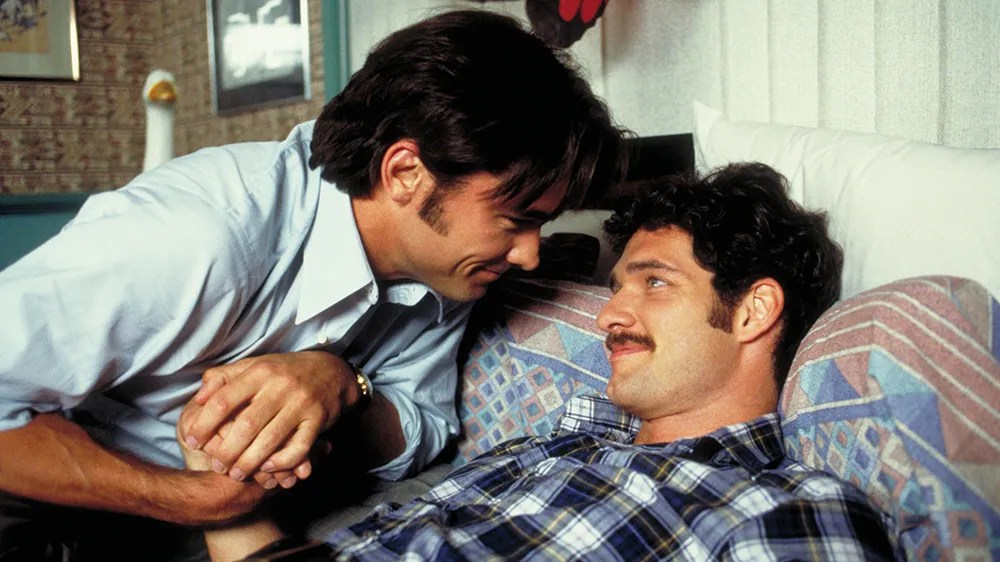
When the Australian Broadcasting Corporation (ABC) aired Tales of the City – a groundbreaking British-made and American-based TV series that prominently featured queer stories – it sparked a debate between Australian audiences through the letters section of the Green Guide.
My new article in the journal, Continuum delves into these letters, revealing how Australian audiences grappled with themes of sexuality in 1994. While it was a derisive, angry and somewhat poetic letter that kicked off the discussion, most letters (5 of the 8) praised the seies, and even the ABC’s bold programming choices. These letters came during a volatile time for queer people in Victoria, just months after the controversial Tasty nightclub raid that targeted its mostly-LGBTIQ+ patrons.
The letters illuminate how Tales of the City became a cultural touchstone, challenging norms and inviting conversations about diversity on Australian screens.
These letters offer a rich archive to understand how television can both influence and reflect cultural change. If you’re interested in media history, queer studies, or Australian cultural discourse, I invite you to read the full article in Continuum.
What next?
I am still digging into the old copies of the Green Guide held by the ASRC. In fact, I went back to 1973 (the earliest copies in their collection), when it was called The Television and Radio Guide. While there are brief mentions of the significant queer storylines in Number 96, The Box, and Prisoner, so far I haven’t found a debte as robust as this one. I’m currently up to 1980, and I’ll continue to work through and chart these letters with more insights to come.
 Damien J O'Meara
Leave a comment